Tuesday, October 15, 2013

Spring at last!

We visited the plot in the middle of July after my return from England and the time was spent restfully reconnecting with nature.


Basking in the winter sun was such a treat after all the rain and cold in Cape Town.


Imagine our surprise when we saw that one of our Wild Olive trees is in fact an Olive tree and was bearing small fruit profusely! We harvested most of the  fruit  for processing, mainly to demonstrate our appreciation of the effort put out by the tree. The fruit was really small!


We returned to the plot in the last week of September, after first visiting friends in Pringle Bay and Stanford. We spent time pruning trees and removing fruit that was draining energy from trees; fruit which we would not  be around to harvest ourselves. 


We could smell the Jasmine from about 30 metres away!


The Acacia Robusta had just started sending out new leaves.


The vicious thorns serve a purpose for the resident Shrikes


 Shrike's pantry

We noticed that many birds were out and about, preparing for the new season. 


 Blue Cranes

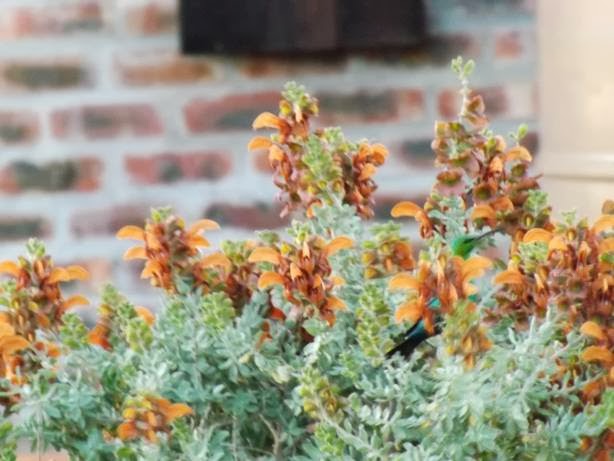
I am so glad that we planted lavender, wild sage and some succulent bushes at the base of most of the trees. The Sunbirds do love them.


Can you see him?


Some typical Renosterveld vegetation is starting to return at last. We pull the Renosterbos out wherever we find it, otherwise nothing else gets a chance to grow. In it's natural situation, Renosterbos is not so overwhelming but on disturbed land, the Renosterbos just takes over in an unnatural way. 

 Wild Lavender (Eriocephalus africanus)


Anthospermum aethiopicum

I noticed that some of the Sand Olives were laden with seed 
while others were still naked. 

We took a few walks to make the most of the good weather before it turned unpleasant.


At the end of our stay, the rain and a heavy wind set in and we were quite glad to be moving on. Our next stop was Laingsburg and this time we had determined to drive via the Seweweekspoort, a route neither of us had ever transversed. 

Little did we know then that we would have to return to Cape Town via the plot because of my absentmindedness on the morning of our departure.

Wednesday, September 4, 2013

Roll on Spring!

I received a message from a friend the other day to ask why I have not written anything on my blog for so long. A combination of factors have stalled the writing process.

Firstly, I spent the last three weeks of June in Leeds, England, visiting my brother daily in hospital and then at his residence, after he underwent a huge operation to replace his aortic heart valve and repair the aortic aneurism that had developed just above the heart. The valve replacement has been on the cards since the age of about 14, but the aneurism was a nasty surprise, discovered in the last two years and increasing the urgency for the operation. We received about seven days notice of the operation date and, as you can imagine, it was a crazy rush to get myself over there before the event. 


Thankfully, Leeds General Infirmary seems to be known for its excellent
 Cardiology Department. 

While not a "Shout it from the Rooftops" kind of believer, my knees certainly saw a bit more action in the prayer department during this time. As back-up, I had notified all my friends, especially those who are known to have a "direct line", to keep prayers ongoing for us during this time and it certainly seems to have delivered a promising result and hope for the future.


Secondly, we have not been up to the plot for ages because every visit now produces angst at how our water supply is being starved by the increase in demand for water. Unfortunately, the topography works against us and the entire system depends on gravity feed and storage tanks that need to be kept full to the brim before we get any decent pressure. A tricky deal if you are only there for a couple of days and you want to check the irrigation system. A permanent owner could just sit and wait for a day with better pressure, no stress.

And finally, freezing any writing urges, this winter has been the wettest we have had in ten years in Cape Town and we have just kept ourselves tucked in against the cold, misery and short days, and not been too active in any department. 

Just recently, the sunsets have improved their showing, in between the rainy outbursts and snow on top of Table Mountain.


Our local wetland is just pouring its heart out and sending surplus water on its way down to the sea.


We have worked on and off in the "new" part of our garden, getting it ready for planting out in Spring. Compost and mulch have been spread over all the re-landscaped surfaces and the process of selecting plants to disguise the retaining structures must begin. I have tons of plants grown from seeds and cuttings, so there is no shortage of resources, that is for sure. 

Old ugly asbestos plant pots thrown out by one neighbour, adorn a wall of retaining blocks, thrown out by another, after some redecorating on our part. 


As usual, Clivias provide a splash of colour in the wintery shade of the garden. They are a little bit early this year but are so welcome.


A few sunny days have seen local wildlife defrosting in the sun. 


The other day, a fully grown Rooikat (Lynx) walked across my garden. I could hardly believe my eyes and was so disappointed that I could not lay my hands on the camera in time. While it is certainly a privilege to see a wild animal like this at such close range, I do worry about the mongoose family living in our garden. We have not seen them since. I am so pleased we do not have to worry about owning a cat which pops in and out of the cat-door. I am sure that a Rooikat would have no problem placing its smaller relative on the menu.

The local yobs sit about in the feeble sunshine, on roof-tops, to check whether there are any edibles available for snatching.


The Blesbok in the nearby Nature Reserve make (eat) 'hay' while the sun shines, before the next rainy moment.


 Roll on Spring!


Saturday, May 25, 2013

Earthscapes 2

The earthscaping project continues unabated. Mondays and Fridays are being reserved by Roy and Siya for this mammoth task. They are both of very slight build and so this heavy job needs the days in between to rest up. Siya does not have any other work so perhaps that is why he returns faithfully to help with this huge task. I think most gardeners would run a mile away from this one.

Progress in photos .....use the white protea flowers as the marker for your bearings.


Notice atop,  the pile of collected mulch just waiting to be used.
 

On the right hand side of this photo below, some indigenous trees are growing "in front" of the curvature of the path of the planned wall. We don't want to pull them out after all these years so we are going to keep them as a mature growth to disguise the block-wall.


Here the wall curves behind the little coppice of mature growth.


We are running out of these blocks to finish the task so, reluctantly, will rebuild one of the "steps" with a different type of block, which a neighbour threw out and donated to our project. Hopefully this will release enough of these  semi-circular blocks to complete the main wall. Fingers crossed. These  square blocks are even less attractive and I hope that I will be able to disguise them by planting shrubs in front of them. What with the awful finish of our neighbours wall, there is much disguising to be done.


Thursday, May 9, 2013

Earthscapes 1

At the same time that we had our house built, in 1988, the owner of the land in front of ours started building his too. His builder sneakily stole huge volumes of soil from our land to fill in the foundation walls of his construction. Once we became aware of it (we were living elsewhere while we built) , we demanded that he cease. He had excavated and stolen the soil from  a second erf that we owned, which purpose was to act as a buffer and garden in front of our house.

So much soil had been excavated that the remaining embankment threatened to collapse. The authorities assured us that the owner of the land in front of us would have to build a retaining wall to stave off this collapse because he was the instrument of its creation. They sent to us a letter which confirmed their ruling. Two years went by and the owner just dragged his heels about any retaining wall. In fact, he never finished building the house and all that lovely soil of ours inside his foundation walls just blew away over the years. What a waste!

Realising that the situation with the remaining embankment was likely to drag on indefinitely, and not wanting to lose any more of our garden soil, we took it upon ourselves to spend precious income (so precious, because we all know how difficult the first years are in paying off a mortgage)  to buy huge, ugly retaining concrete blocks. These would shore up the soil until such time as the municipality enforced their ruling. At one place, the embankment was 3 metres high. In fact, it is illegal to have retaining blocks stacked over 1 metres high without a foundation. But from our point of view, it was  temporary and no building inspector ever came to look at the situation again.


Twenty years on and new owners picked up the reins of building on the property in front of us. They have built the most overpowering dwelling, 8 metres high and taken up almost the entire 500 m2 of their single erf. Different strokes for different folks, I guess. They have managed to take away the view of the coastline from every window in our house. Grateful that we could still see the horizon of the sea, the owner soon sabotaged it by erecting  a monstrous chimney to spoil even that.  (who needs a chimney 1.5mx1.5mx1.5m in size?)

Once they had finished building, they complained to the building inspector about our illegal concrete blocks that had no foundation or drainage. The building inspector demanded that we submit plans and build a properly authorized retaining wall. 

Luckily, I still had the letter from the municipality informing us that the owner of that erf was responsible for constructing a wall. At first we were told by the Cape Town City Council that they would not consider a situation that went back over twenty years.  I argued that if you buy a property for its assets , so you also accept the accompanying liabilities. I felt that this prescribed wall was definitely an inherited liability for the new owner.

Now living on a small income, we could never afford to construct an engineered wall at this stage of our lives. Eventually, for some reason, the building inspector realised that we were not being obstructive or cheeky. We had been totally genuine martyrs in this ongoing long-term situation. So the owners on the property in front were ordered to accept their inherited liability and to add a retaining wall to their construction.


Our adjacent neighbour might take issue with the lack of backfill
 behind the wall, his tree roots now exposed and soil slippage from his side.

It was built over a year ago. I have been itching to rearrange our soil so that we no longer lose part of our garden footprint to our retaining blocks, but waited  to see whether they would plaster or paint the shoddy brickwork on our side of the wall (one can always live in hope!) 


We have given up on that and have started the tricky job of rearranging things. It is likely to take some time. Here are photos of the state of affairs up to this point. Its a process of removing blocks, shifting soil, replacing blocks, reshifting soil into and behind the blocks.  


Star and Midge serve as supervisors on site. 


The photos do not really give an idea of what we are trying to achieve but here is a little sketch again which might give a better idea of our plan. Sadly, we can never fill the garden to its previous levels. We did have an opportunity about three years ago for a huge mountain of soil from a neighbour but while we did use much of it elsewhere in the garden (See Earthworks and the follow-up), we had to refuse at least half of it because we had no idea how long we would have to store the soil(about 9 m3)  while waiting for this wall to be built. So now its a question of shaping it into varying levels along the wall, using the existing soil.


I do hope that the transplanted Wild Camphor survives


Its still a work in progress.
I cannot wait for it to be finished so that we can start planting!!