Monday, October 28, 2013

Karoo Kuier

After the drive through the Seweweekspoort, we settled into Laingsburg for the next two days. 

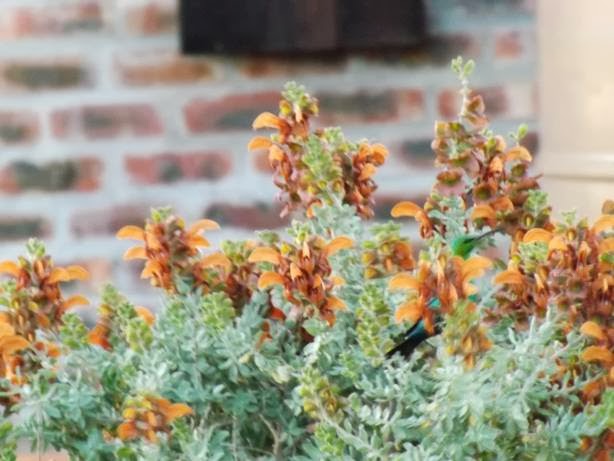
My friend's garden was humming with the birds and (bumble) bees.


The following day we drove out to her nephew's farm in the direction of Sutherland. 

The spring flowers were like jewels scattered across the veld of the farm.


We walked out to the fields of onions and artichokes. 

Apart from the usual sheep-farming, our farmer grows these crops for the overseas seed market.


The first year of growing artichokes is tedious and meticulous, which involves protecting the baby plants from frost. When the plants mature, the female plants have to be hand pollinated with pollen from the male plants. Whew, sounds like a big project to me!


On the return to the farmhouse, we were treated to the most delicious meal of a rare venison stew.


Before we left, we had to explore the wreck of an ancient Chev in a nearby field.


On our way back to Laingsburg, we stopped in at Matjiesfontein. 


We were last there about four years ago and we were astounded at the gardens that have been developed behind the hotel since then.


It seemed unbelievable to think that we were in the middle of the Karoo as we walked through the gentle vegetation.

Friday, October 18, 2013

Seweweekspoort


We set off for Laingsburg at about 10:30 in the morning , and first drove through the Tradouw Pass to join up with the R62. 

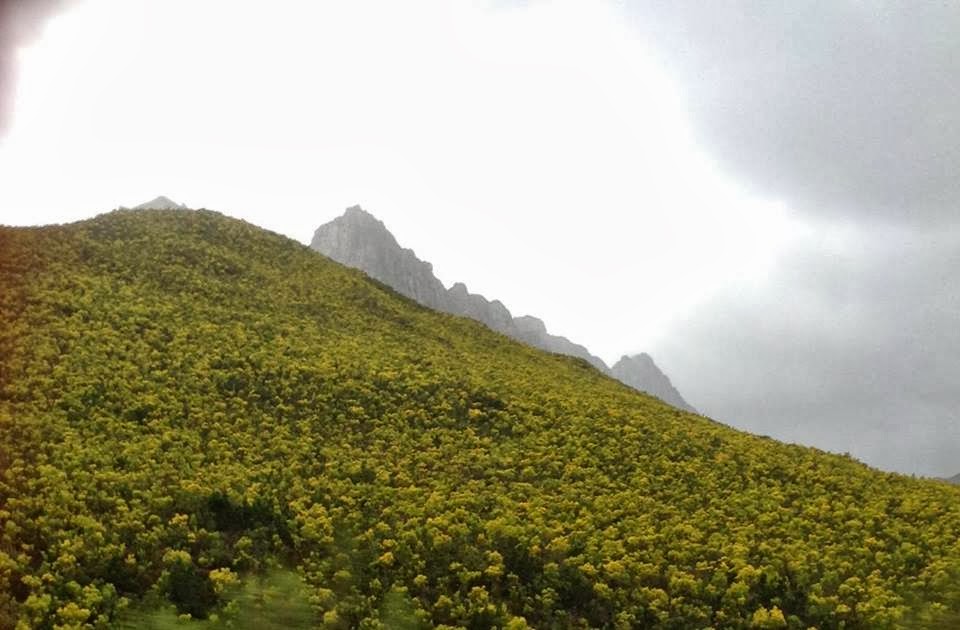
"Twas a misty, moisty morning, cloudy was the weather" but the radiance of the mountainside blooms was not dimmed.


This peak hovering over Ladismith is the highest peak in the Swartberg Mountain Range and, a few days later, we were able to see it from about 40km away, as we traveled back via Anysberg, to retrieve a forgotten item.


As we drove through Ladismith I caught sight of this Coral Tree 
in front of a guesthouse. 
  
(I have become quite adept at snapping photos from a  moving car because neither Englishman nor Mad Dogs enjoy stopping for photo moments too often)

We reached the turn off to Seweweekspoort and approached the mountains
 with anticipation. 


We were well rewarded with the  most amazing rock formations and colours. 


The Pass is only about 18 km long and we felt that it came to an end far too soon. We will have to do this trip again.

 
The other side of the Swartberg Mountains

A puffadder was somewhat annoyed when we turned around to take this photo as it transversed the road. ( safely from the inside of our car, I might add.)


Tuesday, October 15, 2013

Spring at last!

We visited the plot in the middle of July after my return from England and the time was spent restfully reconnecting with nature.


Basking in the winter sun was such a treat after all the rain and cold in Cape Town.


Imagine our surprise when we saw that one of our Wild Olive trees is in fact an Olive tree and was bearing small fruit profusely! We harvested most of the  fruit  for processing, mainly to demonstrate our appreciation of the effort put out by the tree. The fruit was really small!


We returned to the plot in the last week of September, after first visiting friends in Pringle Bay and Stanford. We spent time pruning trees and removing fruit that was draining energy from trees; fruit which we would not  be around to harvest ourselves. 


We could smell the Jasmine from about 30 metres away!


The Acacia Robusta had just started sending out new leaves.


The vicious thorns serve a purpose for the resident Shrikes


 Shrike's pantry

We noticed that many birds were out and about, preparing for the new season. 


 Blue Cranes

I am so glad that we planted lavender, wild sage and some succulent bushes at the base of most of the trees. The Sunbirds do love them.


Can you see him?


Some typical Renosterveld vegetation is starting to return at last. We pull the Renosterbos out wherever we find it, otherwise nothing else gets a chance to grow. In it's natural situation, Renosterbos is not so overwhelming but on disturbed land, the Renosterbos just takes over in an unnatural way. 

 Wild Lavender (Eriocephalus africanus)


Anthospermum aethiopicum

I noticed that some of the Sand Olives were laden with seed 
while others were still naked. 

We took a few walks to make the most of the good weather before it turned unpleasant.


At the end of our stay, the rain and a heavy wind set in and we were quite glad to be moving on. Our next stop was Laingsburg and this time we had determined to drive via the Seweweekspoort, a route neither of us had ever transversed. 

Little did we know then that we would have to return to Cape Town via the plot because of my absentmindedness on the morning of our departure.

Wednesday, September 4, 2013

Roll on Spring!

I received a message from a friend the other day to ask why I have not written anything on my blog for so long. A combination of factors have stalled the writing process.

Firstly, I spent the last three weeks of June in Leeds, England, visiting my brother daily in hospital and then at his residence, after he underwent a huge operation to replace his aortic heart valve and repair the aortic aneurism that had developed just above the heart. The valve replacement has been on the cards since the age of about 14, but the aneurism was a nasty surprise, discovered in the last two years and increasing the urgency for the operation. We received about seven days notice of the operation date and, as you can imagine, it was a crazy rush to get myself over there before the event. 


Thankfully, Leeds General Infirmary seems to be known for its excellent
 Cardiology Department. 

While not a "Shout it from the Rooftops" kind of believer, my knees certainly saw a bit more action in the prayer department during this time. As back-up, I had notified all my friends, especially those who are known to have a "direct line", to keep prayers ongoing for us during this time and it certainly seems to have delivered a promising result and hope for the future.


Secondly, we have not been up to the plot for ages because every visit now produces angst at how our water supply is being starved by the increase in demand for water. Unfortunately, the topography works against us and the entire system depends on gravity feed and storage tanks that need to be kept full to the brim before we get any decent pressure. A tricky deal if you are only there for a couple of days and you want to check the irrigation system. A permanent owner could just sit and wait for a day with better pressure, no stress.

And finally, freezing any writing urges, this winter has been the wettest we have had in ten years in Cape Town and we have just kept ourselves tucked in against the cold, misery and short days, and not been too active in any department. 

Just recently, the sunsets have improved their showing, in between the rainy outbursts and snow on top of Table Mountain.


Our local wetland is just pouring its heart out and sending surplus water on its way down to the sea.


We have worked on and off in the "new" part of our garden, getting it ready for planting out in Spring. Compost and mulch have been spread over all the re-landscaped surfaces and the process of selecting plants to disguise the retaining structures must begin. I have tons of plants grown from seeds and cuttings, so there is no shortage of resources, that is for sure. 

Old ugly asbestos plant pots thrown out by one neighbour, adorn a wall of retaining blocks, thrown out by another, after some redecorating on our part. 


As usual, Clivias provide a splash of colour in the wintery shade of the garden. They are a little bit early this year but are so welcome.


A few sunny days have seen local wildlife defrosting in the sun. 


The other day, a fully grown Rooikat (Lynx) walked across my garden. I could hardly believe my eyes and was so disappointed that I could not lay my hands on the camera in time. While it is certainly a privilege to see a wild animal like this at such close range, I do worry about the mongoose family living in our garden. We have not seen them since. I am so pleased we do not have to worry about owning a cat which pops in and out of the cat-door. I am sure that a Rooikat would have no problem placing its smaller relative on the menu.

The local yobs sit about in the feeble sunshine, on roof-tops, to check whether there are any edibles available for snatching.


The Blesbok in the nearby Nature Reserve make (eat) 'hay' while the sun shines, before the next rainy moment.


 Roll on Spring!